
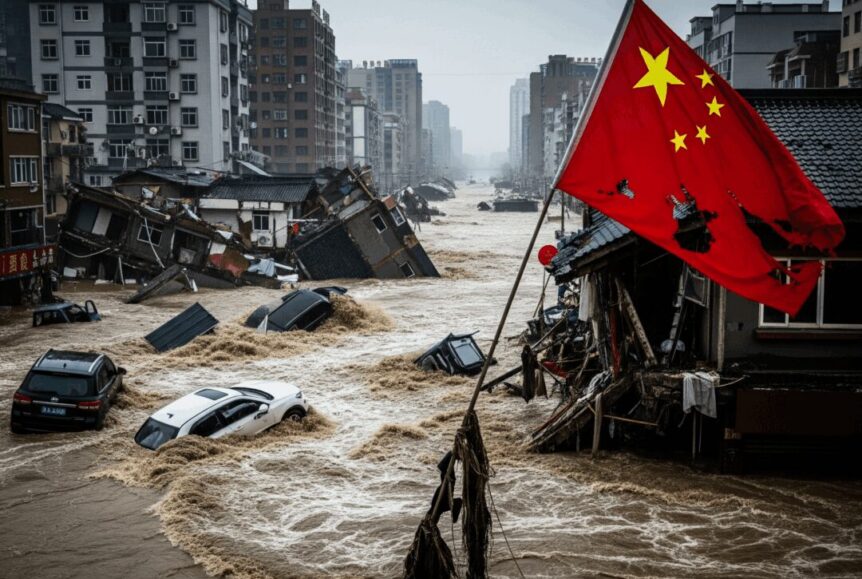
Worst drainage system country in the World China 世界上排水系统最差的国家是中国。
This worst, catastrophic country and its people are killing the entire planet. 这个灾难性的国家及其人民正在毁灭整个地球。
https://blogs.timesofisrael.com/nepal-floods-but-why-is-china-deleting-videos Read original article
What Happened in the Mountains?
The censorship becomes even more troubling because important questions about the disaster remain under investigation.
Early reports suggested that an earthquake may have triggered the collapse. That explanation has since become more complicated. The US Geological Survey initially recorded a magnitude-4.4 seismic event but later determined that the signal was generated by the landslide itself rather than an earthquake.
Satellite imagery showed a huge collapse of glacier and bedrock, followed by an ice-and-rock avalanche that temporarily blocked the river before the natural dam gave way.
That still leaves plenty to investigate.
Reports from Nepal have raised questions about explosive devices washed downstream from the Tibetan side and whether blasting associated with construction or tunnelling could have played any role in destabilizing the terrain.
山中究竟发生了什么?
由于灾难的诸多重要问题仍未得到调查,审查制度显得更加令人担忧。
早期报告指出,地震可能是引发山体滑坡的原因。但后来这一解释变得更加复杂。美国地质调查局最初记录到一次4.4级地震事件,但后来确定该信号是由山体滑坡本身而非地震产生的。
卫星图像显示,冰川和基岩发生大规模崩塌,随后冰石雪崩暂时阻塞了河流,最终导致天然堤坝溃决。
这仍然留下了许多需要调查的问题。
来自尼泊尔的报道提出了质疑,认为可能存在从西藏一侧顺流而下的爆炸装置,以及与建筑或隧道施工相关的爆破活动是否可能对地形的稳定性造成了影响。
What Happened in the Mountains?
The censorship becomes even more troubling because important questions about the disaster remain under investigation.
Early reports suggested that an earthquake may have triggered the collapse. That explanation has since become more complicated. The US Geological Survey initially recorded a magnitude-4.4 seismic event but later determined that the signal was generated by the landslide itself rather than an earthquake.
Satellite imagery showed a huge collapse of glacier and bedrock, followed by an ice-and-rock avalanche that temporarily blocked the river before the natural dam gave way.
That still leaves plenty to investigate.
Reports from Nepal have raised questions about explosive devices washed downstream from the Tibetan side and whether blasting associated with construction or tunnelling could have played any role in destabilizing the terrain.
山中究竟发生了什么?
由于灾难的诸多重要问题仍未得到调查,审查制度显得更加令人担忧。
早期报告指出,地震可能是引发山体滑坡的原因。但后来这一解释变得更加复杂。美国地质调查局最初记录到一次4.4级地震事件,但后来确定该信号是由山体滑坡本身而非地震产生的。
卫星图像显示,冰川和基岩发生大规模崩塌,随后冰石雪崩暂时阻塞了河流,最终导致天然堤坝溃决。
这仍然留下了许多需要调查的问题。
来自尼泊尔的报道提出了质疑,认为可能存在从西藏一侧顺流而下的爆炸装置,以及与建筑或隧道施工相关的爆破活动是否可能对地形的稳定性造成了影响。
Aug 29, 2026, 10:05 AMShare
Please note that the posts on The Blogs are contributed by third parties. The opinions, facts and any media content in them are presented solely by the authors, and neither The Times of Israel nor its partners assume any responsibility for them. Please contact us in case of abuse. In case of abuse,
Report this post.
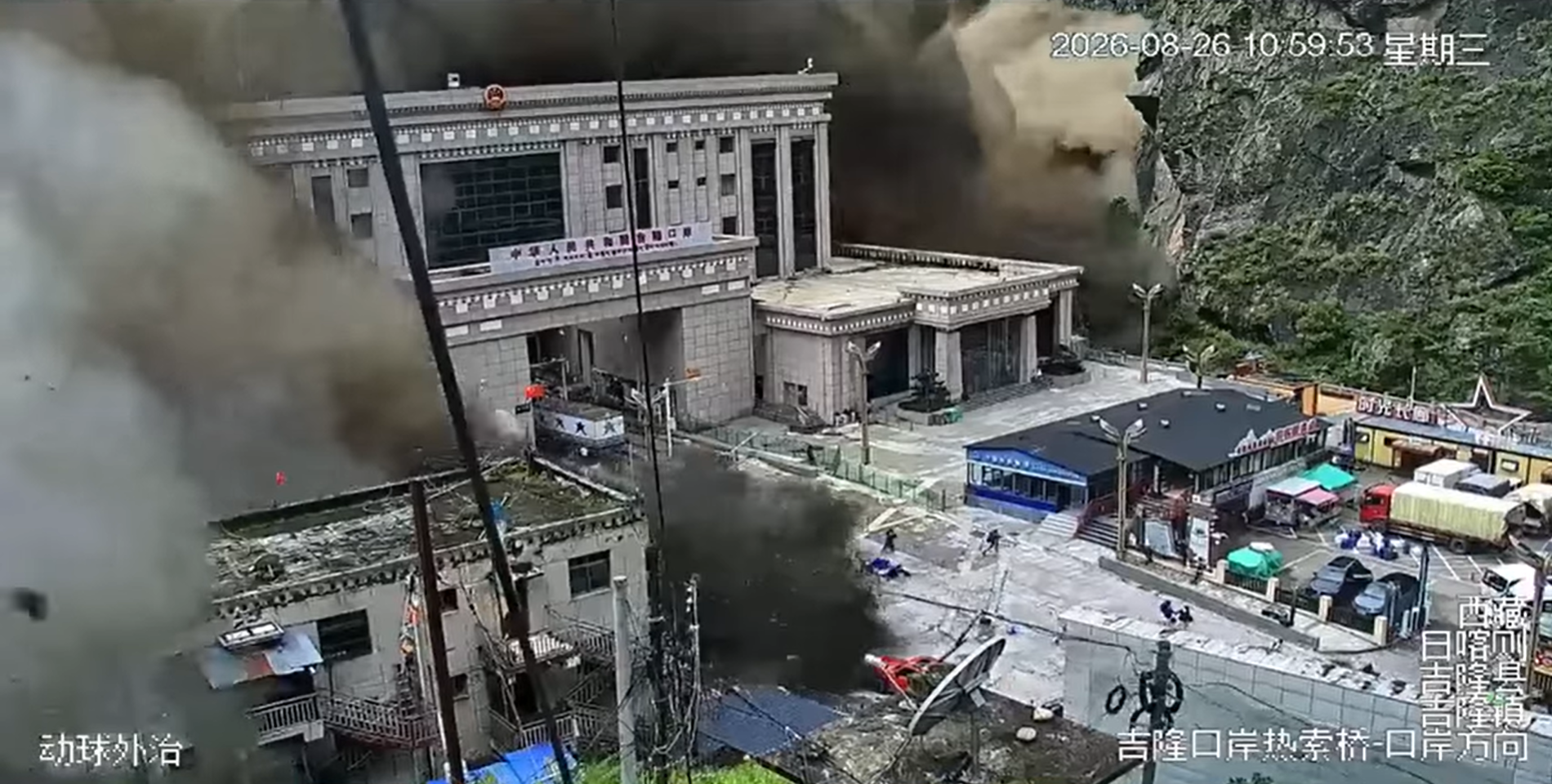
Image: Resound News via X
Access to the Tibetan side is restricted, foreign journalists face serious limitations and citizen footage is being removed from Chinese platforms.
进入西藏一侧受到限制,外国记者面临严重限制,公民拍摄的视频正在从中国平台上删除。
A river does not respect a border, but a censor does. That contradiction sits at the heart of the catastrophe unfolding along the Nepal-Tibet frontier, where a glacier collapse on August 26 sent a massive surge of mud, rock and water through the Lhende Khola and into the Bhote Koshi and Trishuli river systems.
The destruction has been staggering. By August 28, Nepal had reported 579 deaths, with nearly 1,924 people still missing. On the Chinese side, five deaths and 558 missing people were officially reported in Tibet’s Gyirong County, including 260 foreign nationals. Ten bodies were also recovered from rivers in northern India.
But the numbers tell only part of the story. The other part is increasingly about what China does not want people to see.
A Disaster, Then a Digital Cleanup
Within hours of the disaster, videos from the Chinese side began circulating on Chinese social-media platforms. Security footage showed a wall of mud and debris crashing over buildings at Gyirong Port as people ran for their lives. The location and footage were subsequently verified by international media.
Then the videos started disappearing.
Bhutanese journalist Tenzing Lamsang highlighted the removal of flood footage from Chinese platforms, stressing that this was not political protest or anti-government activity. It was disaster footage.
Journalist Aadil Brar similarly reported that citizen videos filmed on the Chinese side were being deleted while footage from Nepal remained widely available.
The distinction is important. A citizen recording a flood is not challenging the Chinese Communist Party. A person filming a collapsing building is not conducting an information war. Yet once those images contradict the carefully managed official picture, they can become inconvenient.
What remained on Chinese platforms was largely the official narrative: rescue operations, government statements, President Xi Jinping’s instructions and limited information about the extent of the destruction.
That creates a remarkably one-sided picture of a disaster.
In Nepal, journalists have been able to travel to affected areas, speak to survivors and publish photographs and videos of the devastation.
In Tibet, foreign access is heavily restricted, particularly around sensitive border areas. The result is predictable: the world can see the destruction in Nepal far more clearly than it can see what happened just across the border.
That is not merely a media problem. It is an information-control problem. And in a disaster, information is part of relief.
What Happened in the Mountains?
The censorship becomes even more troubling because important questions about the disaster remain under investigation.
Early reports suggested that an earthquake may have triggered the collapse. That explanation has since become more complicated. The US Geological Survey initially recorded a magnitude-4.4 seismic event but later determined that the signal was generated by the landslide itself rather than an earthquake.
Satellite imagery showed a huge collapse of glacier and bedrock, followed by an ice-and-rock avalanche that temporarily blocked the river before the natural dam gave way.
That still leaves plenty to investigate.
Reports from Nepal have raised questions about explosive devices washed downstream from the Tibetan side and whether blasting associated with construction or tunnelling could have played any role in destabilizing the terrain.
What were the reported devices? Where did they come from? Were they connected to construction work? Were explosives being used for tunnelling or cutting through the mountains? Were they completely unrelated to the disaster?
These are not unreasonable questions. Yet the very conditions needed to answer them are missing. Access to the Tibetan side is restricted, foreign journalists face serious limitations and citizen footage is being removed from Chinese platforms.
That is precisely how an information vacuum is created.
And an information vacuum does not eliminate speculation. It feeds it.
If Beijing wants the world to accept a particular explanation for what happened, the answer should not be censorship. It should be evidence.
Whose Disaster Is It?
China’s control over the narrative matters far beyond Gyirong.
The river system originating in Tibet does not end there. The Lhende Khola feeds the Bhote Koshi, which flows into Nepal’s Trishuli and eventually becomes the Gandak in India. Thousands of people in Bihar and other downstream areas have already faced evacuation and flood warnings.
Last year, another flood in the Bhote Koshi killed nine people and left 24 missing, while destroying the Friendship Bridge connecting Nepal and China. That disaster was reportedly linked to the draining of a supraglacial lake in Tibet.
This is becoming a pattern that the countries downstream cannot afford to ignore.
The Tibetan plateau is one of Asia’s most important water towers. Decisions made there — whether involving infrastructure, roads, tunnels, hydropower or environmental management — can have consequences far beyond China’s borders.
Yet the people living downstream are being asked to trust information coming from a region where independent access is severely constrained.
That is unacceptable.
China has deployed rescue personnel, drones, search dogs and other emergency resources, and Premier Li Qiang has visited the affected region. But a government can conduct rescue operations and censor information at the same time. One does not cancel out the other.
The issue is not whether China has sent rescuers. The issue is whether China is allowing the world to see what those rescuers are finding.
A government facing a natural disaster should not fear citizen footage. It should preserve it. Journalists should be able to examine the damage. Scientists should be able to study the terrain. Independent experts should be able to compare satellite imagery, eyewitness accounts and official statements.
Instead, the pattern emerging from Tibet is the opposite: restricted access, disappearing footage and an overwhelmingly official narrative.
That is why China’s censorship matters.
It is not simply about a few videos being removed from Weibo or Douyin. It is about controlling the historical record of a disaster that has crossed three countries.
2026年8月29日 上午10:05
分享
请注意,“博客”栏目中的文章均由第三方投稿。文章中的观点、事实和任何媒体内容均由作者独立呈现,《以色列时报》及其合作伙伴对此不承担任何责任。如有任何滥用行为,请与我们联系。如有任何滥用行为,
请举报此帖。
图片:Resound News via X
进入西藏一侧的通道受到限制,外国记者面临诸多限制,公民拍摄的视频也被中国平台删除。
河流不尊重边界,但审查者却会。这种矛盾正是尼泊尔-西藏边境正在发生的灾难的核心所在。8月26日,冰川崩塌,裹挟着泥石流和水流涌入伦德河,最终汇入博特科西河和特里苏里河水系。
这场灾难造成的破坏令人震惊。截至8月28日,尼泊尔报告死亡人数为579人,另有近1924人失踪。中国方面,官方报告称西藏吉隆县有5人死亡,558人失踪,其中包括260名外国公民。此外,在印度北部河流中还发现了10具遗体。
但这些数字仅仅揭示了部分真相。另一部分则越来越与中国不愿让世人看到的有关。
灾难之后,是一场数字清理
灾难发生后数小时内,来自中国方面的视频开始在中国社交媒体平台上流传。监控录像显示,吉隆港的建筑物被泥石流和瓦砾掩埋,人们四散奔逃。随后,国际媒体证实了事发地点和视频的真实性。
之后,这些视频开始消失。
不丹记者丹增·拉姆桑指出,中国平台删除了洪水视频,并强调这并非政治抗议或反政府活动,而是灾难现场的真实影像。
记者阿迪尔·布拉尔也报道说,中国境内拍摄的民众视频遭到删除,而尼泊尔的影像资料却广泛流传。
这种区别至关重要。民众拍摄洪水并非挑战中国共产党,拍摄建筑物倒塌也并非发动信息战。然而,一旦这些影像与精心营造的官方形象相悖,就会变得棘手。
中国平台上保留下来的几乎全是官方叙事:救援行动、政府声明、习近平主席的指示以及关于灾情严重程度的有限信息。
这造成了灾难的片面性。
在尼泊尔,记者可以前往灾区,采访幸存者,并发布灾情照片和视频。
在西藏,外国记者的准入受到严格限制,尤其是在敏感的边境地区。结果可想而知:世界更容易看到尼泊尔的灾情,而不是仅仅看到边境另一侧的灾情。
这不仅仅是一个媒体问题,更是一个信息控制问题。在灾难中,信息是救援的一部分。
山区究竟发生了什么?
由于灾难中一些重要问题仍未得到调查,审查制度显得更加令人担忧。
早期报告指出,地震可能是引发崩塌的原因。但后来这一解释变得更加复杂。美国地质调查局最初记录到一次4.4级地震事件,但后来确定该信号是由山体滑坡本身产生的,而非地震。
卫星图像显示,冰川和基岩发生大规模崩塌,随后冰石雪崩暂时阻塞了河流,最终导致天然堤坝溃决。
这仍然留下了许多需要调查的问题。
来自尼泊尔的报道引发了人们对从西藏一侧顺流而下的爆炸装置的质疑,以及与建筑或隧道施工相关的爆破是否可能对地形的稳定性造成了影响。
报道中提到的装置是什么?它们来自哪里?它们与建筑工程有关吗?是否使用了炸药进行隧道挖掘或山体开挖?它们与这场灾难完全无关吗?
这些问题并非不合理。然而,回答这些问题所需的条件却缺失了。进入西藏一侧的通道受到限制,外国记者面临诸多限制,公民拍摄的视频也被中国平台删除。
这正是信息真空的形成方式。
而信息真空并不会消除猜测,反而会助长猜测。
如果北京希望世界接受某种特定的解释,那么答案不应该是审查,而应该是证据。
这场灾难究竟是谁的?
中国对舆论的控制远不止于吉隆。
发源于西藏的河流系统并未止于此。伦德河汇入博特科西河,博特科西河流入尼泊尔的特里苏里河,最终在印度汇成甘达克河。
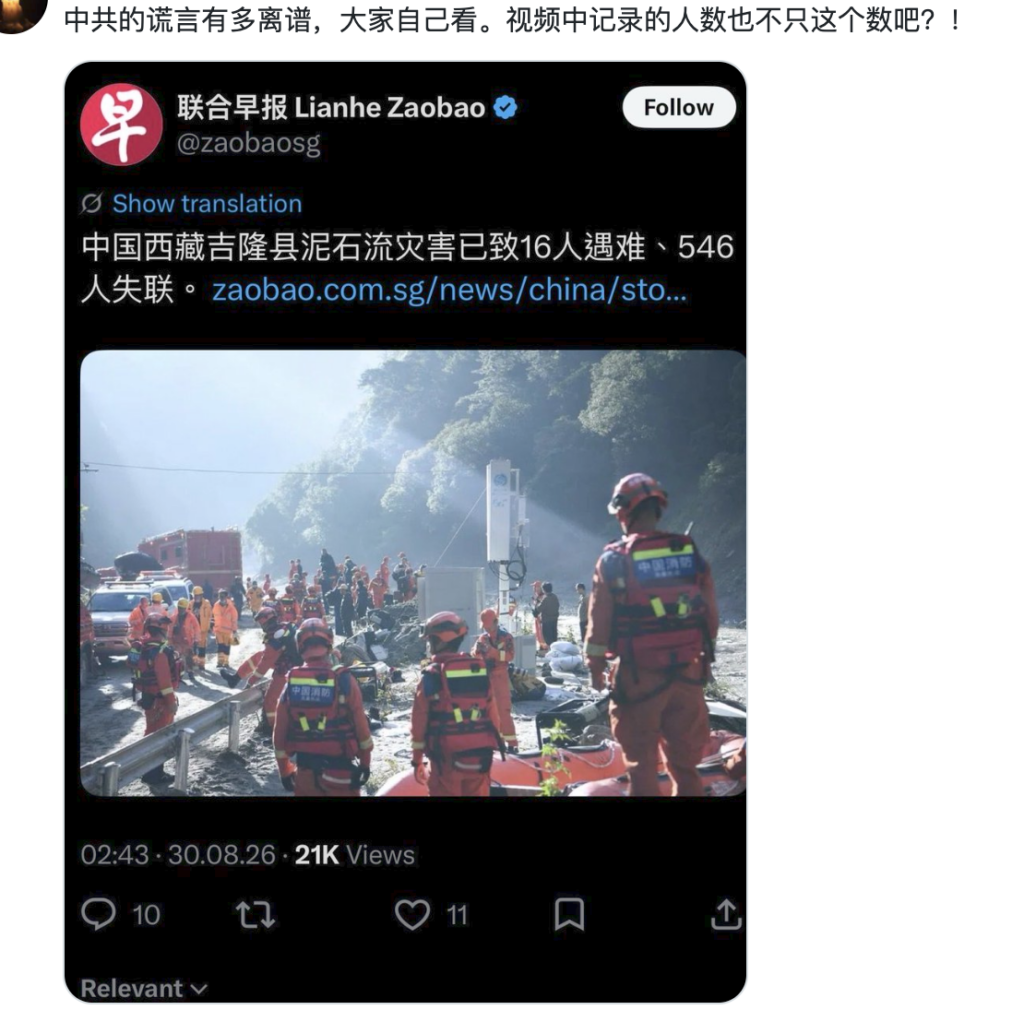


Explosive material founded that was used in China for explosion on construction site 在建筑工地发现曾用于中国爆炸的爆炸物
Never forget China and Chinese people and Xi jinping.. The historic VIRUS Spreader 永远不要忘记中国、中国人民和习近平……历史上的病毒传播者